Showing posts with label Renault. Show all posts
thumbnail

Renault Clio


2013 Renault Clio

 Since the launch of the original model in 1990, some 11.5 million Clios have been sold in more than 115 countries. Today, a new chapter in Renault Clio's history is about to be written with the unveiling of the fourth-generation version.

"New Clio is set to make a real mark. In addition to an unprecedented package of innovations, its design marks a major shift from that of previous models." Carlos Tavares (Chief Operating Officer)


New Renault Clio, an incarnation of the brand's new styling identity

New Renault Clio is the first production model to give full expression to the Renault design renaissance inspired by Laurens van den Acker, Senior Vice-President, Corporate Design. The promise was to take the style and emotion of the brand's latest concept cars and carry them over to production models. Renault's new supermini fulfils that promise.

"New Renault Clio was conceived as a piece of sensuous sculpture which stimulates desire. Like muscles, its curves express the dynamism radiated by the DeZir concept car. No acute or aggressive angles, just voluptuous curves that make you want to go up to it and caress it." Laurens van den Acker (Senior Vice President, Corporate Design)


Balanced, dynamic exterior proportions

New Clio stands out through its front-end design which features a prominent Renault logo, set bold and upright to a gloss black background, an arrangement first seen on the DeZir concept car. This frontal treatment is further emphasised by the headlights - the lower edge of which is picked out in chrome - and LED daytime running lights. Offered only in five-door form, New Renault Clio has a sporty silhouette, accentuated by integrated rear door handles concealed close to the rear quarter lights. In comparison with its predecessor, it packs extra dynamism and personality thanks to a lower ride height, wider tracks, wheels pushed out wide within the arches, and a reduction in the gap between the wheels and wheel arches. From launch, New Clio will be offered in a choice of eight body colours, including the launch colour which is derived from the red used for DeZir.


A fresh, welcoming, occupant-friendly cabin

Safe, protective and refreshing, the interior of New Renault Clio perfectly complements the exterior style to inspire confidence and energy. Comfort goes hand-in-hand with a modern feel and user-friendliness thanks to the dashboard sculpted in the shape of an aircraft wing, the optimally-positioned multimedia system on the centre console, a wide range of colour options, a digital speedometer, comfortable seats and chrome and gloss-black trim highlights.


Broadest-ever personalisation programme & long list of affordable options

Exterior and interior personalisation was dialled into New Renault Clio's design process at the outset. From launch, buyers will be able to personalise the outside of their car with a selection of colour touches to the front grille, rear and side door inserts. To personalise the interior, the menu covers the dashboard, door panels, steering wheel, grab handles, gear lever and air vent surrounds, upholstery materials and optional floor mats. Thanks to attractively-priced option packs, buyers are able to choose the look and feel they prefer.


New Renault Clio: packed with innovations

When it comes to innovation, Renault's new supermini retains Clio's tradition of redefining expectations within its class and raising the standards for small cars.


Renault R-Link - an integrated tablet connected to the car and internet

Having been first with notable innovations such as steering wheel-mounted radio controls (1982, R11 Electronic) and in-car navigation (1994, Safrane), after bringing keyless entry to the volume market (in 2001) and GPS navigation with a high-resolution screen (Carminat TomTom® priced at £450 for Clio in 2009), and having launched on-board connected navigation in the shape of Carminat TomTom® LIVE for Clio, Renault continues its stream of innovations with Renault R-Link.

Available as standard from Dynamique upwards for New Clio, Renault R-Link provides a bridge between the car and the connected world outside thanks to:

• A wide seven-inch (18cm) touchscreen, intuitive voice commands and, as a market first, a home page that can be personalised by the user for safe and simple access to essential functions, without the driver having to take his or her eyes off the road.
• + TomTom® connected navigation includes Live services and boasts the market's best real-time traffic information, helping to minimise journey times and fuel consumption.
• + Among other benefits, a connection with the car's own electronic systems permits access to an advanced eco-driving function (Driving eco²) which analyses the driver's behaviour and provides advice to help reduce fuel consumption.
• + Thanks to the Renault R-Link Store, the automobile world's first ever Application Store, users can easily view or download a comprehensive and varied range of apps from their car or computer (via 'My Renault').
• The scope of Renault R-Link's connected functions will continue to expand thanks to 'Paris Incubateurs' (a Paris-based hot-house for young talent) and to an appeal extended to start-ups at the LeWeb'11 show. Over and above the services provided by TomTom® LIVE and the COYOTE app, which alerts the driver to dangerous situations (in countries where this feature is available), R-Link users can also check their messages, for example, manage their diary, locate the nearest service station or place to park, or send a tweet….

One Renault R-Link app - Renault R-Sound Effect - enables the audio experience inside New Clio to be personalised by immersing the cabin in a specific sound environment. It can simulate six different engine sound profiles, each with a specific, attractive signature and perfectly synchronised with driving parameters such as speed and acceleration.


A world first: Bluetooth® radios with the Renault Bass Reflex system

All versions of New Renault Clio are available with a clever sound system integrated into the front doors' loudspeakers. Known as Renault Bass Reflex, this system delivers the volume and listening enjoyment of a 30-litre home speaker system. Bass frequencies are more powerful and the threshold of saturation and distortion is pushed much higher.

The entire New Clio range features Bluetooth®-equipped radios for hands-free telephone operation and audio streaming from portable music players with excellent sound quality. All radios incorporate USB and jack sockets.


New Renault Clio: a pleasure to drive, and targeting number one status for fuel economy and low CO2 emissions

New Renault Clio combines low fuel consumption with driving pleasure thanks to a significantly updated range of petrol and diesel engines. The two petrol engines (Energy TCe 90 and TCe 120) combine very low fuel consumption and CO2 emissions with responsive performance and mid-range acceleration. The significantly improved new-generation Energy dCi engines bestow New Renault Clio with record-breaking fuel economy for the same driving pleasure.


New Energy TCe 90 petrol engine

New Clio is the first Renault model to feature the new three-cylinder petrol turbocharged Energy TCe 90 engine. This is the first three-cylinder powerplant ever produced by Renault and, from launch, will provide a remarkable balance between driving pleasure and fuel economy:
•This three-cylinder, turbocharged 899cc unit comes with Stop&Start and delivers the performance of a normally-aspirated 1.4-litre powerplant,
•An ultra low-inertia turbo for satisfying response from low engine speeds: 90hp and 135Nm at 2,000rpm (90 per cent of peak torque available from 1,650rpm to 5,000rpm),
•An economy-optimised version with taller gear ratios and fuel consumption of 65.7 mpg, equivalent to CO2 emissions of 99g/km,
•A 21 per cent fuel consumption and CO2 emissions savingc compared to the TCe 100 it replaces


New diesel Energy dCi 90

The latest addition to the Energy family is a new 90hp version of the 1.5 dCi, equipped with Stop&Start:
• A four-cylinder 1.5-litre engine with 220Nm of torque available from 1,750rpm, an increase of 20Nm over the current dCi 85,
• An economy-optimised version with taller gear ratios which also qualifies for the Renault eco2 signature with fuel consumption of 88 mpg, equivalent to CO2 emissions 83g/kmc.


New TCe 120, paired with six-speed EDC automatic transmission

New Clio will be available with the new, dynamic TCe 120 engine mated to six-speed EDC transmission (Efficient Dual Clutch), a first for Renault in the B segment:
• A four-cylinder 1.2-litre engine with the performance of a normally-aspirated 1.6 engine,
• Direct fuel injection and turbocharging for peak power of 120hp and 190Nm of torque from 1,750rpm.

This engine is currently in the process of being homologated and will become available in the first half of 2013. It will be among the most powerful, yet most economical, engines in its class.

Along with the availability of EDC dual clutch transmission for the dCi 90 engine in the first half of 2013, New Renault Clio will mark a further step in expanding access to the driving pleasure and seamless gearshifts delivered by this responsive and frugal automatic transmission.


Systems designed to promote economical driving

Over and above these engineering features, New Clio offers drivers an integrated suite of efficient solutions to help them reduce their fuel consumption and CO2 emissions:
• An ECO mode allows drivers to reduce fuel consumption by as much as 10 percent by modifying the car's performance parameters at the push of a button.
• A driving style monitor (green, yellow or orange) and a Gear Change Indicator (GCI) on the dashboardd help drivers improve their driving style to reduce their fuel consumption.
• The Driving eco²app available through Renault R-Link provides drivers with a full suite of information, enabling them to analyse their driving style and take corrective measures in order to reduce their fuel consumption and CO2 emissions.


New Renault Clio: a pledge of quality and safety

Manufactured in Flins (France) and Bursa (Turkey), New Renault Clio is built to Renault's exacting quality standards. It is an affordable model that sets high standards in quality, with nothing to fear from larger or more expensive models. New Clio is built on a new version of the Alliance's B platform which has been optimised for outstanding comfort, manoeuvrability and low noise levels.

Safety runs in the family: in 2005, Clio III became the first B-segment model to achieve a five star EuroNCAP crash test rating. Thanks to the comprehensive list of safety features it offers, New Clio, too, seeks to deliver the highest level of safety.


Renault is celebrating the launch of New Clio with an innovative, interactive digital strategy delivered in three principal parts:
• From July 4, 2012, internet users will be able to view New Renault Clio from all angles, plus photos and videos, at www.clio.renault.[country],
• From July 12, 2012, Renault will be inviting the website's visitors to take a virtual test drive of the car by immersing themselves in an interactive film,
• Lastly, in September 2012, users will experience the final phase of the launch with a surprise linked in to the promotional film.

From July 4, this range of personal and interactive digital experiences will be available at www.clio.renault.[country], a promotional toolkit which will function on computers, tablets and smartphones.


The Clio success story: 22 years, and counting!

Launched in 1990, Clio can already look back at a career spanning 22 years, with more than 11.5 million cars sold in more than 115 countries. During that time, Renault Clio has played a pivotal role in the history not only of Renault but also of the European market for small, versatile cars. Its trademark throughout has been to draw the segment upwards by bringing the qualities and equipment levels of superior classes to a wider audience. Clio is the only car to have been awarded the Car of the Year title twice.
• 1990: Clio I goes on sale, winning the Car of the Year award for 1991.
• 1991-1993: Introduction of Clio Williams and Clio Baccara, highly regarded sports and premium versions.
• 1998: Launch of Clio II, the first car in its segment to earn a four-star EuroNCAP crash test rating. It also popularised the separate display for the radio, automatic climate control and navigation with a colour screen.
• 2000: Renault Clio Renault Sport and Clio V6 explode onto the sports scene.
• 2005: Debut of Clio III, the first B-segment model to score a five-star EuroNCAP crash test rating. Widespread take-up of the Renault-card keyless entry system.
• 2006: Clio III is named Car of the Year.
• 2007: The segment's first 1.2 litre petrol turbo engine.
• 2008: For the first time, Renault Clio is available in Sport Tourer form.
• 2009: Launch of Carminat TomTom®, bringing navigation to the volume market.
• 2010: Renault Clio celebrates its 20th anniversary, as sales reach more than 11 million units.

source : Renault Press
thumbnail

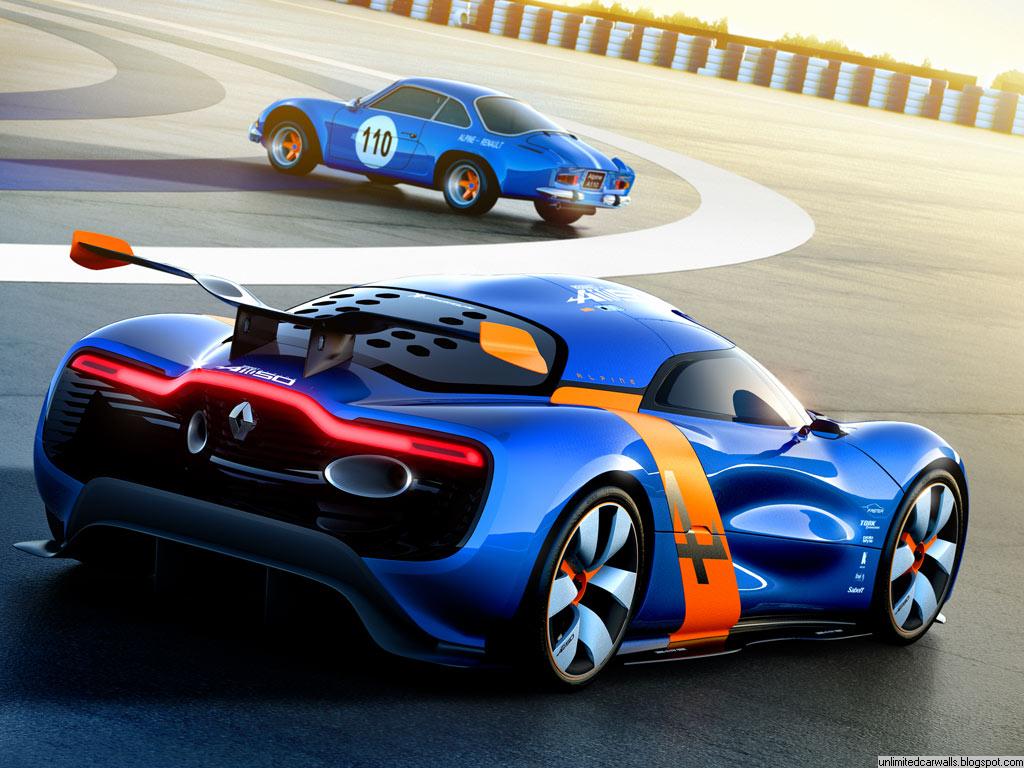
Renault Alpine A 110-50 Concept


2012 Alpine A 110-50 Concept


The Alpine Berlinette turns 50 this year and, to mark the event, Renault has created the Renault Alpine A110-50 concept car, dedicated to performance and driving enjoyment.

So what's in a name? In some cases, the heritage of a name is like a national treasure - and that's certainly true for Alpine. Its DNA blends Renault's sporting passion and technical expertise.

  • The Renault Alpine A110-50 concept car translates the most characteristic design features of the original A110 in a modern and spectacular way.
  • The carbon-fibre bodywork features a new shade of blue which refreshes and reinterprets the famous original 'Alpine Blue'.
  • Produced with the renowned expertise of Renault Sport Technologies, the Renault Alpine A110-50 concept car is imbued with the world of motorsport. It benefits from the experience gained from the racing Mégane Trophy by using the same technical platform.

"Developing this concept car was a great adventure. It was a catalyst for creativity. We wanted to make a Berlinette that was of our time, and which boldly embodies Renault's passion for motorsport. We were guided by our hearts and emotions." - Axel Breun, Concept and Show Car Director.

A new interpretation of a timeless design

To mark the 50th anniversary of the iconic Berlinette, Design Yann Jarsalle and Concept and Show Car Director Axel Breun reinterpreted the original design cues to include the new Renault design language introduced by Laurens van den Acker with the DeZir concept car, and which will soon be rolled out in the company's future models. The new front-end look, with the upright, confident diamond, has been adapted for this very low and wide car. The Renault Alpine A110-50 is a car of today; a bold embodiment of Renault's passion for motorsport.

"For everybody on the team, it was a dream come true to work on an Alpine concept car. We wanted to put this car firmly in the modern day, while resonating with its heritage" - Laurens van den Acker, Senior VP, Corporate Design.

The Renault Alpine A110-50 concept car translates the most characteristic design features of the original A110 in a modern and spectacular way with:

  • the sculpted forms of its elegant, flowing bodywork, enhanced by lights over which air seems to flow effortlessly.
  • the half-domed additional lamps, with a technical but nostalgic interpretation, thanks to full LED yellow lighting - as it should be!
  • a characteristic 3D rear window, which reveals the mid-rear engine.
  • air intakes on each side echo the ducts on the rear wheel arches of the Berlinette. The right-hand opening is for gearbox cooling, the left is for the engine bay.


Produced by Faster, the carbon-fibre bodywork features a new shade of blue which refreshes and reinterprets the famous original 'Alpine Blue'. Every opening panel does so with dynamics worthy of the finest GTs, with the bonnet hinged at the front and the engine bay cover opening towards the rear. The doors feature a scissor motion.

"The car is very curvy, like the Berlinette, while expressing the three key words of our new design policy: simple, sensual and friendly" - Axel Breun.

A competition-focused cockpit

As you climb into the driving seat, the eye is drawn to the carbon-fibre sills. Everything inside this two-seater expresses build quality and sportiness, with black dominant.


  • the driver's seat features embroidered 'Renault Alpine A110-50' badging, Sabelt full harness belts and different, attractive shades of blue.


  • the dashboard is particularly uncluttered. The Renault Design-created steering wheel incorporates a colour screen and houses the same technology as a Formula Renault 3.5 single-seater to provide drivers with all the information they need.


  • Racing driver equipment is provided by Sabelt and the helmet is created by Ruby.


  • A true prototype

    Produced with the renowned expertise of Renault Sport Technologies, the Renault Alpine A110-50 is imbued with the world of motorsport. It benefits from the experience gained from the racing Mégane Trophy by using the same technical platform. Acclaimed by drivers in the World Series by Renault, the tubular chassis of the Renault Alpine A110-50 has been stiffened and undergone several developments. The roll cage and bracing in the engine bay have been modified (lowered) in the workshop of Tork Engineering to adapt them to the vehicle's height, which is lower than that of Mégane Trophy. The digital design work was led by Renault Design, Koller and Etud Integral, while final assembly was carried out by Protostyle. The final weight distribution is almost ideal, with 47.8% over the front wheels.

    To facilitate servicing, the concept car features integral pneumatic jacks. Derived directly from the systems seen in endurance racing, they allow the wheels to be changed extremely quickly.

    An exceptional car that fuses elegance and aerodynamic efficiency

    The efficiency of the Renault Alpine A110-50 concept car is largely generated by ground effect. At the front, a splitter hidden in the bumper generates low pressure, which results in significant aerodynamic downforce. At the rear, a diffuser accelerates air flow beneath the floor. Ground effect therefore accounts for more than one-third of the car's downforce, with the rest coming from an adjustable rear wing.

    The research and design of this air flow was conducted using Computational Fluid Dynamics, a cutting-edge technology used particularly in F1. CFD involves studying movements of a fluid, or their effects, by resolving digitally the equations which govern the fluid. This technique was used by Renault Sport Technologies primarily in order to fine-tune the aerodynamics and study the behaviour of the New Mégane Trophy as a function of air flow.

    Exemplary road holding

    The wheelbase of the Renault Alpine A110-50 is identical to that of Mégane Trophy (2,625mm), while the track is slightly wider at 1,680mm front and 1,690mm rear.

    The 21-inch wheels, with a single central nut, are specific to this car and fitted with roadhomologated Michelin tyres.

    The Sachs dampers can be adjusted in compression and extension, and are mounted directly onto the lower wishbones. There are numerous different set-up options: castor, camber and alignment, ride height, anti-roll.

    In order to improve driver feedback, driving aids like ABS, traction control, etc. are not fitted.

    Serious stopping power

    The braking capability of the Renault Alpine A110-50 match its performance. At the front, large 356mm-diameter steel discs are slowed by six-piston callipers. At the rear, the discs are 330mm in diameter, while the callipers are four-piston models.

    Mechanical excellence

    Developed on the same technical platform as Mégane Trophy, the Renault Alpine A110-50 concept car also boasts the same chief technical characteristics.

    It runs the Renault V4Y engine block, a 3.5 litre 24-valve 400hp V6 mounted in a mid-rear position. The crankcase (semi-wet), moving parts (pistons, connecting rods, crankshaft), valve train (camshafts and valve springs) and exhaust system are specific compared to the version featured on productions models.

    Furthermore, the Renault Alpine A110-50 uses the carbon air intake employed for Mégane Trophy V6.

    The inlet manifold is fed by a new roof-mounted air intake. This development broadens the engine's power band, with additional horsepower at all engine speeds. The engine mapping has been optimised for these modifications.

    F1-style transmission

    The Renault Alpine A110-50 concept car is fitted with a semi-automatic six-speed sequential gearbox, as well as a twin-plate clutch that can be controlled using either the clutch pedal or a paddle on the steering wheel.

    The gearbox is fitted longitudinally behind the engine and incorporates a limited-slip differential (discs and ramps) with adjustable pre-loading.

    The cerametallic twin-plate clutch is also specific to the car. It is activated automatically when downshifting, guaranteeing fast and reliable gear changes.

    A black box at the heart of Renault Alpine A110-50

    Supplied by Magneti-Marelli, the Marvell 6R electronic control unit includes functions for engine management, gearbox control and data acquisition.

    Even more accurate data acquisition

    All data collected by the Renault Alpine A110-50 can be analysed using version 4 of the benchmark Wintax software. Wintax 4 enables advanced analysis of more than 50 parameters: engine speed, gear, steering angle, car speed, throttle position, brake pressure... This information allows drivers and engineers to optimise settings and driving style. Wintax 4 data analysis also enables even faster diagnosis of any technical problems.

    "Developing this concept car was a great adventure. It was a catalyst for creativity. We wanted to make a Berlinette that was of our time, and which boldly embodies Renault's passion for motorsport. We were guided by our hearts and emotions." - Axel Breun.

    Renault Alpine A110-50 - The legacy of the Berlinette

    When Jean Rédélé unveiled the A110 Berlinette at the 1962 Paris Motor Show, it marked the start of an Alpine adventure for the engine from the Renault 8. The car had been developed from the Alpine A108, but was more stylish and more dynamic, with an even lower engine cover, a larger glazed area and the rear lights from the Renault 8. The new engine demanded changes to the air intakes: with the radiator mounted at the rear, cooling exits were opened in the resin bodywork behind the rear wheel arches, disguised with four chrome strips. The changes served only to heighten the elegance of the A110 Berlinette. The restrained, balanced silhouette maintained its extremely pure lines.

    A car for the enthusiast

    To drive a Berlinette is a life-changing experience. Above all, it was designed to win rallies, so it's not surprising that it boasts a certain pedigree; not a tricky personality, but real character. You don't climb aboard an Alpine, you slide into it. But once you're behind the wheel, the connection is immediate. Agility and traction are particular strong points thanks to the mid-rear position engine, which tends to produce oversteer that is easy to control using the steering and throttle. It's sometimes a little trickier to keep going in a straight line, but life's all about compromise... This isn't a car you simply take for a drive - it demands to be properly driven. Its weaknesses are also its strengths.

    The Berlinette in motorsport

    The light weight and handling qualities of the Berlinette meant it was perfectly suited for motorsport. As well as being fun to drive, the cars were favourites with the fans, who often saw them cornering hard at lurid angles. It's almost impossible to catalogue every motorsport triumph for the Berlinette, but these are the main stages of the adventure.

    1961-1968: the early successes

    José Rosinski took the first win for the A110 at the 1963 Rallye des Lions. The remainder of the season followed this trend, with exploits including a win for Jacques Cheinisse on the Rallye d'Automne.

    In the years that followed, a number of 'privateer' drivers achieved success at national and international level ahead of much more powerful cars from well-established brands.

    1967: assembling a great team

    Alpine became Alpine-Renault. New drivers joined the line-up: Gérard Larrousse, Jean-Claude Andruet and Jean-Pierre Nicolas in the works team, but also, among others, Bernard Darniche in the privateer ranks.

    1968: the first French Rally Championship title

    After victories on the Neige et Glace and Rallye de Lorraine for Gérard Larousse, Jean-Claude Andruet claimed the French title thanks to a total score of four wins during the season.

    1969: Hitting its stride

    Jean Vinatier and Jean-Claude Andruet were the stars of the season, with the former going on to become the French Rally Champion at the end of the year.

    1970: European and French titles

    The Berlinette 1600S was homologated for Group 4, which finally allowed the car to fight on almost equal terms with more powerful competitors. Jean-Claude Andruet, who had calmed his approach after several notable incidents, was crowned French and European Champion.

    1971: The Berlinette dominates the Rallye Monte-Carlo

    Another good year. Ove Andersson won the Rallye Monte-Carlo. Thérier finished second and Andruet third. Andersson also took the win in Italy against the flotilla of Fiats and Lancias dispatched to beat him. He subsequently triumphed on the Austrian Alpine Rally and on the Acropolis, securing the international title for Alpine. Jean-Pierre Nicolas won the French Championship.

    1972: Heading for glory

    The 1,600cc engine was replaced by a more powerful 1,800cc unit. Jean-Claude Andruet dominated the Tour de Corse. Numerous wins followed, shared between the team's drivers. Darniche was crowned French Champion at the end of the year, while Jean-Luc Thérier claimed the Rallye des Cévennes driving a turbocharged 1,600cc version. This was the first stirrings of a technology destined for major success...

    1973: The climax of an era

    Just imagine the best French drivers of the era: Andruet, Darniche, Thérier, Nicolas and Piot ably supported by the experienced Andersson. What's more, a team of mechanics giving their heart and soul, plus a car at the peak of its development. The season began with victory for Andruet on the Rallye Monte-Carlo, followed home by four other Alpines. In Portugal, Thérier and Nicolas scored a one-two. On the Rallye du Maroc, Darniche was unbeatable. And the rest of the season followed the same trend. Alpine won the inaugural World Rally Championship title and Jean-Luc Thérier was crowned French Champion.

    1974 - 1975: the end of the works era

    Nicolas won the Rallye du Maroc and finished second on the Tour de Corse. This was the Berlinette's swansong, and the year produced the last major win for the A110 on the Critérium des Cévennes, driven by Jacques Henry.

    Technical specifications

    CHASSIS
    • Type: Tubular 25CD4S steel chassis with semi-load bearing engine and gearbox


  • BODYWORK
    • Carbon
    • Aerodynamic features: Front splitter, diffuser, rear wing


  • ENGINE
    • Position: Longitudinal, mid-rear
    • Type: Renault V4Y - 6 cylinders - 24 valves - 3,498 cc
    • Bore x stroke: 95.5mm x 81.4mm
    • Injection/ignition: Magneti-Marelli Marvell 6R
    • Maximum power: 400 hp @ 7,200 rpm
    • Maximum torque: 422 Nm @ 6,200 rpm
    • Maximum revs: 7,500 rpm


  • TRANSMISSION
    • Type: Rear-wheel drive
    • Gearbox: Six speeds + reverse - sequential
    • Gear shift: Semi-automatic (pedal-operated clutch and paddle)
    • Differential: Limited slip differential
    • Clutch: Cerametallic twin-plate 184 mm-diameter clutch


  • SUSPENSION & BRAKES
    • Suspension: Double wishbones, adjustable two-way Sachs damper/spring assemblies, front anti-roll bar
    • Front brakes: Ventilated steel discs (Ø 356mm x 32mm) with six-piston AP Racing callipers
    • Rear brakes: Steel discs (Ø 330mm x 32mm) with four-piston AP Racing callipers


  • WHEELS & TYRES
    • Wheels: Aluminium alloy - Front: 8 x 21 / Rear: 9.5 x 21
    • Tyres: Michelin 245-35 x 21 (front) and 265-35 x 21 (rear)


  • DIMENSIONS, CAPACITIES
    • Length: 4,330 mm
    • Width: 1,961 mm
    • Height: 1,230 mm
    • Front/rear track: 1,680 mm / 1,690 mm
    • Fuel tank: 30 litres
    • Kerb weight: 880 kg


  • source : Renault Press
    thumbnail

    ZOE


    2013 Renault ZOE

    ZOE is Renault's solution to Zero Emission mobility for all. In addition to being a first class choice for everyday use and readily affordable (from just €15,700) Renault ZOE is the first pure-electric car to be designed from the ground up as such. ZOE is packed with the latest technology and boasts no fewer than six world premieres geared to enhancing user-friendliness, range and connectivity.

    For the first time, the conditions necessary for the widespread roll-out of electric vehicles are well and truly in place.

    Unveiled at the 2012 Geneva Motor Show, Renault ZOE will go on sale autumn 2012. Its launch marks the beginning of a new era: an era of electric vehicles for all.

    Style imbued with purity and emotion

    Renault ZOE's final design is being world-premiered at the 2012 Geneva Motor Show. Designed as a pure-electric car from the ground up, ZOE is a compact hatchback with sleek, fluid lines. Its agile, dynamic looks express driving enjoyment, while its signature headlights feature LEDs that permanently light up recesses situated either side of the front air intake. Like Twingo and Twizy, ZOE features the Renault brand's new design identity.

    Electric mobility for all, from just €15,700

    Today, for the first time, it is possible to buy an electric vehicle at a price close to that of a diesel-engined city car in markets where tax incentives are available. For example:
    •In France, tax-paid prices for Renault ZOE start from €15,700 (with tax incentive of €5,000 deducted).
    •In the United Kingdom, where a subsidy of £4,333 is available, tax-paid prices for ZOE start from £13,650 (equivalent to €16,450 at current exchange rates).

    Even in countries where tax incentives are not currently available, prices for Renault ZOE are still particularly attractive. In Switzerland, for example, ZOE's catalogue price is CHF 22,800, which is equivalent to approximately €18,900 at current exchange rates).

    The cost of leasing the battery starts from €79/month (price for a 36-month contract and a distance travelled of 12,500km/year), inclusive of comprehensive breakdown assistance (which covers flat batteries).

    Since March 6, it has been possible to pre-order ZOE in 11 countries at a bespoke website (Renault-ZE.com). Customers who reserve Renault ZOE will be offered a test drive and will be contacted on a priority basis as soon as the car goes on sale.

    ZOE, a raft of innovations for a new form of motoring

    More than 60 patents have been filed for ZOE's design. Range, interactivity and occupant wellbeing are at the core of the vehicle's innovations.

    Renault ZOE, the first mass-market electric vehicle to be homologated with an NEDC cycle range of 210 km

    In terms of autonomy, Renault has developed the 'Range OptimiZEr', that combines three major innovations (new-generation regenerative braking, a heat pump and MICHELIN EnergyTM E-V tyres). Due to this, the range of ZOE is the highest of the electric vehicles in mass production. In the NEDC cycle, ZOE is homologated with a range of 210km. In real conditions, for example, in suburban use, the owner will generally achieve around 100km in cold weather and 150km in temperate conditions.

    New-generation regenerative braking recovers practically all of the energy otherwise wasted during braking, without any significant impact on ZOE's onroad dynamics. The car offers a perfectly smooth drive with no jarring electric motor braking. The system works in two ways:
    •The kinetic energy produced under deceleration and braking is recovered by the motor so that it can be converted into electricity to charge the battery. This feature is also fitted to Fluence Z.E. and Kangoo Z.E.
    •When the driver presses the brake pedal, the system intelligently distributes the braking effort between applying the brake pads and the electric motor brake with a view to maximising the use of the electric motor brake and charging of the battery.

    The heat pump provides excellent thermal comfort without detracting from the vehicle's range. This system, which operates in the same way as reverse-cycle air-conditioning, consumes very little electricity. It produces warm or cool air by simply reversing the cycle of operation. The heat pump generates approximately 2kW of cooling or 3kW of heat with just 1kW of electricity. The cabin temperature is also more constant since it is not affected by the heat given off by the motor.

    The MICHELIN EnergyTM E-V tyre is a Michelin innovation co-developed with Renault as a world premiere for Renault ZOE. The tyre features enhanced energy efficiency to maximise vehicle range. Its rubber compound, tread design and sidewalls have been engineered to withstand ZOE's high torque and address the specific demands of electric vehicles, yet it still delivers the same safety and handling performance as all other Michelin tyres. Available in 15- and 16-inch versions, this tyre is fitted to all ZOE models as original equipment.

    The Chameleon charger revolutionises electric vehicle charging

    Renault ZOE is the only electric vehicle to feature the Caméléon charger. Patented by Renault, this charger is compatible with all power levels up to 43kW. Charging batteries at a charging station can take between 30 minutes and nine hours. For example, ZOE can be charged in an hour at 22kW. This intermediate power level extends battery life and puts less pressure on the power grid than the fast-charging of batteries at 43kW.

    The Chameleon charger allows fast-charging at charging stations at a quarter of the cost

    Fast-charging stations are currently equipped with high-power chargers. Now that the Caméléon charger is fitted to the vehicle, there is no longer any need for chargers at charging stations. New fast-charging stations will be opened which are easier and more cost-effective. They will cost less than €3,000, a quarter of the cost of existing fast-charging stations. Charging stations of this type are being previewed on the Renault stand at the 2012 Geneva Motor Show.

    Brand-new Renault R-Link multimedia system on ZOE

    Renault ZOE is the first Renault vehicle to be presented with Renault R-Link, Renault's brand-new integrated, connected multimedia system. To enable drivers to control its functions without taking their eyes off the road, R-Link features a large seven-inch display, steering wheel-mounted controls and speech recognition. R-Link also delivers integrated connectivity with motoring services and applications available from the R-Link Store. When released, R-Link Store will offer more than 50 applications adapted for life on the move thanks to an active partnership with application developers. These apps will be downloadable directly inside the car or via owners' My Renault account.

    R-Link also includes a host of new functions dedicated to electric motoring and range management: histogram of energy consumption, display of energy flows and preprogramming of battery charging. The navigation system offers bespoke services such as a display of the vehicle's operating radius based on the range remaining in the battery, suggestions for the most energy-efficient itineraries and the location of nearby battery charging stations (depending on country), as well as their real-time availability. R-Link also lets drivers view their eco-driving performance and improve their technique with 'eco-scoring' and tips (general and personalised).

    Connected services for remote communication and monitoring

    ZOE drivers will be able to use their mobile phone or computer to:
    •access range-related information using the 'My Z.E. Connect' package, available on ZOE from the entry-level version.
    •monitor their vehicle via the 'My Z.E. inter@ctive' Pack which includes: ◦remote operation (on/off) of battery charging if the vehicle is connected to a charging station.
    ◦remote programming of charging (from a PC only) with the option of taking advantage of preferential rates from electricity suppliers.
    ◦immediate or delayed activation of the cabin pre-conditioning system.

    A relaxing, enjoyable drive

    Driving Renault ZOE is a unique experience which gives new meaning to the term 'driving pleasure'. The synchronous electric motor with rotor coil has a power output of 65kW and instantly delivers maximum torque of 220Nm. Acceleration and pull-away are responsive from low speeds. Driving is more relaxing thanks to the silent ride and smooth, gearshift-free acceleration.

    For stress-free driving in built-up areas, ZOE is fitted with 'Z.E. Voice', an alarm which warns pedestrians that the vehicle is approaching. 'Z.E. Voice' can be heard from 1 to 30kph and was the subject of special design work to create a bespoke sound identity for ZOE. The driver can choose between three different sounds, while it is possible to turn off the warning system by simply pressing a button.

    The perfect temperature inside Renault ZOE's cabin

    Programmable pre-conditioning heats or cools ZOE's cabin when the vehicle is charging. When the driver gets into the car, the cabin is just the right temperature and the energy used for the thermal comfort system is not drawn from the battery.

    The air breathed in by ZOE's occupants is purer

    An activated charcoal cabin air filter traps most bad smells and pollutants. It also filters substances just a few microns in size, such as pollen and soot.

    The 'Zen' version embodies the world of ZOE

    The choice of colours and materials for the 'Zen' version recalls purity and wellbeing: white, blue and chrome, plus a soft-feel dashboard. Renault ZOE Zen is fitted with 'Take Care by Renault' equipment as standard.

    Launched with Renault Latitude, the 'Take Care' signature is a guarantee of premium features dedicated to occupant wellbeing and travelling comfort. In addition to the pre-conditioning function and active charcoal cabin filter, it includes:
    •A relaxing or stimulating scent diffuser. The effectiveness of the scents has been proven by a study conducted by the German institute Psyrecon.
    •A dual-mode purifying and relaxing air ioniser: the purifying function eliminates the bacteria found in the cabin air. The relaxing function generates negative ions to produce a balance with the positive ions, which are present in high concentrations in a confined space such as a car's interior.
    •A toxicity sensor: this system detects excessive pollution levels and automatically switches on the air recycling mode in the cabin.
    •Teflon® upholstery protection, for easier cleaning: this invisible, odourless treatment is both waterproof and stain-proof.

    ZOE underpins Renault's environmental commitment

    Like all electric vehicles, Renault ZOE emits no CO2, NOx, CO or fine particles. It also signals the disappearance of unpleasant smells and 'engine' noise during road use. Well-to-wheel CO2 emissions depend on the energy-generation mix of each country. Emissions total 62 g / km of CO2 in Europe, versus 89 g / km for the new Toyota Prius. They are even lower in France at just 12 g / km of CO2.

    From 2013, ZOE's local content rate will be 55 per cent following the introduction of the Renault electric motor which will be produced at the company's Cléon plant. This high rate helps to reduce the carbon footprint of logistics activities.

    ZOE complies with the very latest criteria required to qualify for the Renault eco² signature:
    •It is manufactured at Renault's ISO 14001-certified factory at Flins, France.
    •As required by Renault's eco-friendly hallmark, its CO2 emissions are less than 120g/km.
    •ZOE is 85 per cent recyclable, while nine per cent of the plastic it contains is sourced from recycling.

     source : Renault Press
    thumbnail

    Twingo RS


    2012 Renault Twingo RS

    New Renault Twingo RS, which will go on sale from mid-March 2012, features the sporting interpretation of Renault's new styling identity, including a dynamic grille design with four lights and a front bumper incorporating an F1-style blade. This detail, which now runs across the Renault Sport range, recalls Renault's success in Formula 1. The hallmark Sirius Yellow finish will be available as an option from the end of May. The rear end of the car features a tailgate-mounted lip spoiler, a special bumper incorporating a diffuser and aerodynamic extensions on the rear wheel arches. Also available is a Design Pack which includes Grey/Dark Gunmetal Grey door mirror housings, F1 blade and RS lip spoiler, plus chrome details for the fog light surrounds. It will also be possible to specify new 16-inch 'Emotion' alloy wheels complete with 'R.S.'-badged centre caps which proudly proclaim the car's pedigree.

    Trademark Renault Sport yellow stitching will feature inside Renault Twingo RS (on the steering wheel, seats and dashboard cowl), while the dashboard, radio console, rev-counter housing and lateral air vents all come with Gloss Black inserts. The top of the steering wheel, seat backs and cushions, rev-counter surround and manual climate control controls are picked out in white.

    Renault Sport expertise

    New Renault Twingo RS brings the driving enjoyment and sporty performance associated with Renault Sport Technologies' experience of motorsport to an even wider audience:
    •a feisty, normally-aspirated 1.6 16V R.S. engine (133hp/98kW at 6,750rpm, and 160Nm of torque at 4,400rpm),
    •outstanding road holding with the standard Sport chassis. The optional Cup chassis (ride height lowered by 4mm) is an exceptional feature in new Renault Twingo RS's class,
    •big brakes: 280mm-diameter front discs and 240mm-diameter rear discs,
    •unique for a small hot hatch: the optional RS Monitor, a functional and fun on-board telemetry system.

    Despite its exceptional performance credentials for its class, Renault Twingo RS boasts low CO2 emissions (150g/km, a saving of 3.2 percent compared to the former version) and fuel consumption (6.5 litres/100km, a saving of 3.0 percent).

    A promise of quality supported by a network of specialists

    Since its launch in September 2008, Renault Twingo RS has emerged as a top-three seller in its class (A segment / Very High Performance), with sales totalling more than 10,000 vehicles.

    Like its bigger sisters, Clio RS and Mégane RS, new Twingo RS is supported by a network of 350 Renault Sport specialist dealers across the world, for expert servicing dedicated to performance cars.

    Twingo Gordini RS: the 'French Touch', plus premium features as standard

    Thanks to its instantly recognisable style, 17-inch diamond-effect black wheels, leather trim and automatic climate control, new Twingo Gordini RS defines sporty chic in imitable fashion with its twin stripes. In addition to the blue interior option, a new grey interior can now be specified, irrespective of body colour (Malte Blue, Glacier White, Pearlescent Black or Vif Red). New Twingo Gordini RS adds a touch of refinement to the attraction of the Renault Sport range.

    About